Monday, March 25, 2013

Burlap-crete Fence 3

I staggered the fence line to make it more interesting and added a little house paint to the last layer of mortar. I like the subdued color. I'm no longer using grout, but soaking the burlap in bonding agent, then saturating it the same mortar mix I'm spraying. I'm spraying three to four coats of three parts sand, one part Portland cement. The wall  feels pretty substantial, though I've not taken a hammer to it, and probably won't.


Thursday, March 7, 2013

Homemade Mortar Sprayer Update

My homemade mortar sprayer has been working well for my experiments with burlap-crete.( http://papercreteparadise.blogspot.com/2012/08/a-low-rent-mortar-sprayer.html)  However, when I tried to replace the air gun with one (I thought was) just like it, I found that the threads of the coupler inside the PVC fitting were too short to engage those on the air gun. Though both were purchased at Harbor Freight, the air guns were slightly different. Which means not every air gun will work in this system without some additional retrofitting. I had to grind away some of the thickness of the PVC with a Dremel tool, and also cut the little curled ring off the new air gun to make it work. Also, I’d used a Clorox bottle at first because I happened to have one. A gallon Concrete Bonding Agent jug is sturdier and is a tighter fit.


Saturday, March 2, 2013

Burlap-crete Fence Experiment 2

Finished section of burlap-crete fence after touching up with mortar (where I hadn't taken tall fence posts into account and cut the burlap short, and where overlaps of burlap were showing). This is after several coats of sprayed-on mortar. 

Burlap soaking in bonding agent. Weather held me up, so it soaked several days.

Burlap saturated with grout. I don't know if grout is necessary. I'm going to try a section using the same Portland cement mortar mix I've been spraying with.

Draped over existing fence. It's wired to the fence here and there, but is basically just hanging on it.

Using Clorox bottle mortar sprayer.


Sunday, February 10, 2013

Burlap-crete fence experiment 1

These three photos are of my experiment with making a section of burlap-crete wall. I soaked raw burlap in bonding agent, saturated it with grout, draped it over wire, and sprayed it with several coats of mortar made from one part Portland cement to three parts sand using my Clorox bottle sprayer (http://papercreteparadise.blogspot.com/2012/08/a-low-rent-mortar-sprayer.html). The armature for this section includes some hardware cloth, wire fencing, and other scraps I had laying about, but the plan for the rest of the wall is to simply drape the burlap over my existing wire fence. After curing a couple of days this burlap-crete seemed thin and fragile, but two days of days of rain did it good, and I'm pleased with how sturdy it is. I'll still be spraying more layers of mortar. I'm adding a little lime to the mortar mix as I move down the line, thinking it will allow for more flexibility. I searched for a local source of the magnesium-based cement I read about on a green building site (http://blog.greenhomebuilding.com/2010/03/magnesium-based-cement.htmwith no luck. If anyone knows of a possible source in the midlands of South Carolina, let me know.


Burlap saturated with grout, draped over wire armature.


Burlap after spraying mortar.

Monday, January 21, 2013

Tatched Roof 3

I finished coating the roof. The final mixture was one part cement to two parts of aggregate, plus asphalt emulsion. So each batch included four parts sand, two of cellulose insulation, three of cement. It was easiest, after the dry ingredients tumbled awhile in the mixer, to rake some into a large plastic bowl, add water, and mix by hand (rather than in a bucket with the drill), then add the asphalt emulsion. I would just scoop some asphalt emulsion -- maybe two handfuls --out of the bucket into the bowl of damp mix and knead it until it was evenly distributed. I daubed the stuff on. Thin coats work best. It was pleasant to work with. I used a broken CD as a tool to created the thatched look. The crete lightens as it cures.

Monday, January 7, 2013

"Thatched" Roof 2 & Staining Faux Bois Planters

Continuing work on the "thatched" roof using an asphalt emulsion mix.


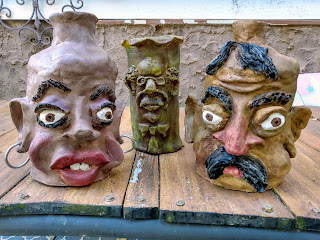
Experimenting with staining a couple of efforts at faux bois planters. I've thus far experimented with a commercial dye called Smith's Color Floor, a manganese carbonate/potassium dichromate mixture (I didn't enjoy using this so much because of potential toxicity), and iron and zinc oxide.
No need to include muriatic acid in a mix of water and iron or zinc oxide. The oxide stains the concrete without acid. I'm unhappy with the finished product but feel like it's a start. Next plan is to make some "patties" from my mortar mix as described by the great Donald Tucker so that I can practice mixing the various colors of oxide, etc. A great starting point for infomation related to using oxides and other fairly inexpensive substances to stain concrete is here: http://www.stainedfloor.com/. I purchased my chemicals from various sellers on Ebay.
The small pot is made over a burlap/grout armature.

Tuesday, January 1, 2013

Burlap Cement & Asphalt Emulsion Experiments

This so-called gazebo structure is an amalgam of papercrete recipes. In that way it taught me a good bit about papercrete -- the recipes improved over the weeks of layering. But some of the areas first covered are soft, and rain was actually eroding them. I wanted to extend the umbrella roof, creating an eave for aesthetics but also to help keep the rain off those soft sections until I can invest the time to save or re-do them.

The roof is made from a picnic table umbrella coated with a latex paint/cement/sand mixture. It seems to be holding up, but I didn’t see how to attach lathe or hardware cloth as an armature for an eave.


I wound up using raw burlap soaked in bonding agent, then saturated with crack resistant grout. I was inspired to try this approach by this great website (http://annesley.wordpress.com/burlap-crete-explained/). I could not find the rapid set grout this author writes about, and settled for Quickrete Professional Crack Resistant Grout purchased at Lowes.

Doing a section the width of the burlap  at a time, I just lay a double layer of the grout-saturated cloth in place at roof's edge and used a board to prop the overhang up until it cured. I wrapped the board in cellophane sandwich wrap to help keep the grout from adhering to it. After I saturated the burlap with grout and positioned it, I added more layers of grout, then let it cure several days before removing the board. I wouldn't try to do pull-ups from it, but it seems very sturdy.

I've begun layering the entire roof with a papercrete mixture including asphalt emulsion (2 parts sand, 2 parts cellulose, 1 part portland cement, a nice gob of asphalt emulsion. I let the dry mix tumble in the mixer for awhile, put a little in a bucket, added water, drill mixing until crumbly, then mixed in the asphalt emulsion by hand).

I'd used this mix layering a section of the gazebo (the issue at that time was getting papercrete to stick to the armature, and I really like the finished product. I'm interested to see how this mix holds up to the South Carolina humidity, sun, and heat. I'm trying to create a sort of layered, thatched look on the roof.